How Does Race and Ethnicity Impact the Definition of Family
Many debates about gimmicky family trends involve a clash betwixt 2 schools of thought, 1 emphasizing demographic and economical factors and the other emphasizing culture, morality, and religion. The research cursory released atFamily Studies last week has revealed those error lines once more.
In the brief, we explored how states' varying levels of family stability chronicle to their voting patterns in presidential elections. Teens are most likely to have grown up with their continuously married biological parents in the nation's bluest and reddest states, according to data from the Census Agency'south American Community Survey. We argued that the most liberal states foster family stability partly past emphasizing the value of instruction and delayed family unit germination, while the most conservative states accomplish high rates of family unit stability partly because of their normative and religious delivery to marriage.
Some observers believed the brief did not give sufficient weight to a third gene: how race and ethnicity affect states' family unit stability. For example, Naomi Cahn and June Carbone, whose work on red and blue families the brief referred to, criticized David Leonhardt'south analysis of it atThe Upshot for "largely dismiss[ing] the influence of racial factors," and others have argued that the link between a land's political culture and its rate of family stability all but disappears when race and education are controlled for. (Zill offers a response to that line of statement hither.)
The word the brief generated raises two primal questions:
1) How does family stability in America vary by race and ethnicity?
2) Does the scarlet-state/blue-country pattern in family unit stability play out similarly or differently for whites, African Americans, Hispanics, and Asian Americans?
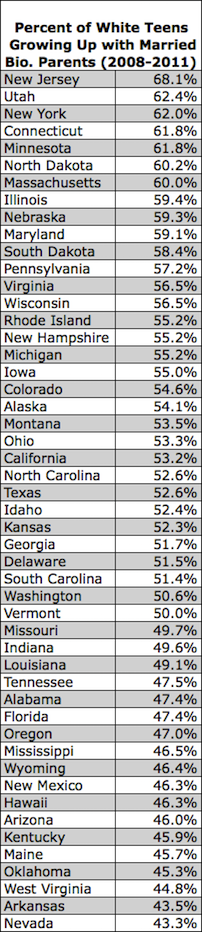
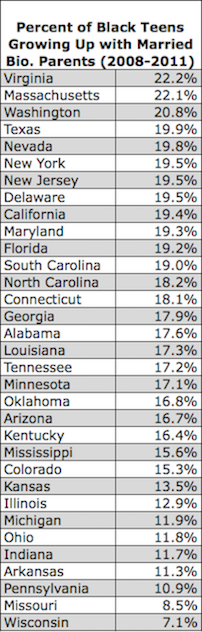
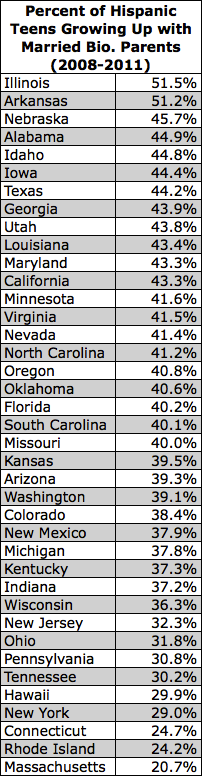
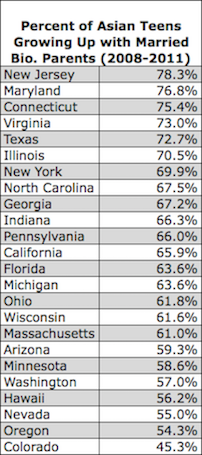
There are marked differences in family unit stability by race and ethnicity in America. Adolescents from Asian-American families (65 percent) are most likely to alive with their married biological parents. Fifty-four percent of white teenagers alive with their married biological parents, compared to 41 percent of Hispanic and 17 percent of African American adolescents. Family stability in America conspicuously varies by race and ethnicity.
Do these racial and indigenous variations, in plow, explicate away the differences in family unit stability by political civilisation we reported in this space terminal calendar week? No. Controlling for race and education reveals a minor but statistically meaning, positive link betwixt our Carmine State Index score and the proportion of fifteen- to 17-yr-olds living with their continuously married parents in recent years (2008-2011). Simply examining the geographic patterns for each of the 4 primary racial groups—white, black, Hispanic, Asian—tells us that the crimson-state/blue-country story is not the same for each of these groups in America.
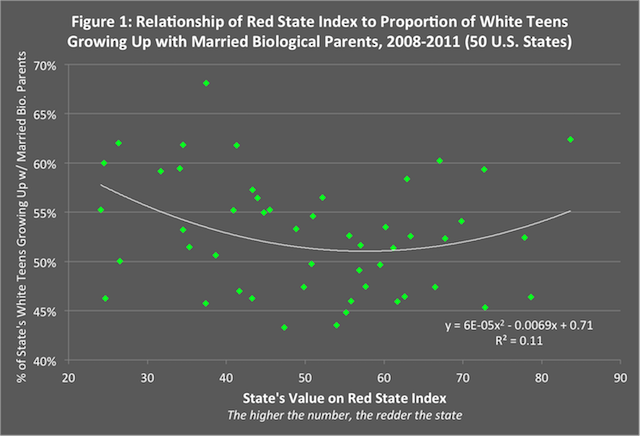
The scatterplot for white teens resembles the scatterplot for all teens (an unsurprising finding given that whites are the largest racial grouping). This means that white teens are most likely to live with both of their married parents in the bluest and reddest states in America. So white teens in red states like Utah and Due north Dakota are especially likely to live intact families, equally are white teens in blue states similar New Jersey and New York.
Information technology as well ways, as Leonhardt's accent on the Due north-South parenting separate would suggest, that white teens living in the South (including the Southeast) are the least likely to live with both married parents. White children in Arkansas and Nevada are specially likely to abound up outside of an intact family.
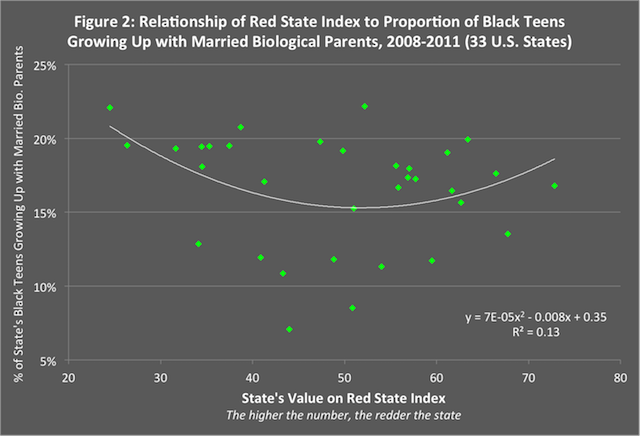
The political credo–family stability relationship for blackness teens is similar to that of white teens, as a comparison of the two scatterplots shows, and the Red State Index score explains a like amount of country-to-state variance in family stability amid whites and blacks. (Nosotros but included in the scatterplot states with a population of African Americans large plenty to produce reliable estimates, and did the same for Hispanics and Asians below.) Interestingly, the North-South parenting dissever does not employ in a straightforward fashion to African Americans. African Americans are nigh probable to alive with both parents in Virginia, Massachusetts, and Washington, and least probable to live with both parents in Pennsylvania, Missouri, and Wisconsin.
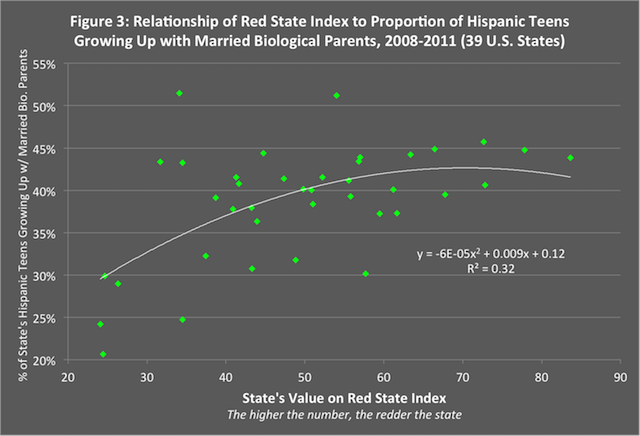
Surprisingly, the link betwixt family stability and Reddish Country Alphabetize score is strongest among Hispanics. That is, political ideology explains more land-to-state variance in family stability levels for Hispanics than for any other racial group. Indeed, Hispanic teens in very blue states are considerably less likely to have grown up with their continuously married birth parents than their counterparts in redder states. However, the limerick of the Hispanic population varies between states in terms of national origin (Puerto Ricans brand upwardly a higher share of the Hispanic population in the blue states of Connecticut, Massachusetts, and New York than in the ruddy states of Texas and Nebraska, for example). Immigrant/nativity status of Hispanics also varies beyond states, and that variable is relevant to family formation as well. All of which makes state-level trends among Hispanics harder to analyze. We are hesitant to depict firm conclusions virtually the association between political civilization and Hispanic family unit stability before exploring these issues further.
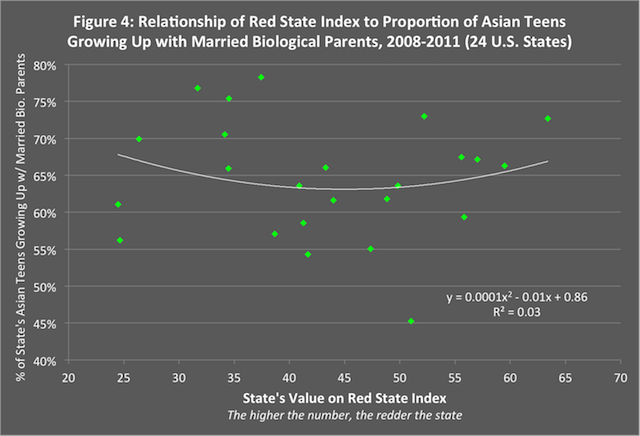
On average, Asian teens are more likely than teens in any other racial/ethnic group to have grown upward with their married biological parents. The relationship between that measure and the Red Land Index score for Asians is very weak. But only 24 states have an Asian population large enough to yield reliable estimates from ACS data, and the national origins of Asian Americans, like those of Hispanics, vary from one region to another, which makes information technology difficult to describe conclusions about family formation patterns among Asians as a group.
Equally these figures illustrate, the Red State Alphabetize–family stability link varies somewhat between different racial/ethnic groups. But the link for teens of all races combined is non only a product of states' racial demographics. Equally the full research brief explains in greater depth, teens' chances of enjoying a stable family are also shaped by education levels and by culture. That ways American children—including white and black children—are most likely to grow up in an intact, married abode in the bluest and reddest states in America.
Nicholas Zill is a psychologist and survey researcher who has written on indicators of family and child wellbeing for four decades. Prior to his retirement, he was the head of the Child and Family unit Study Surface area at Westat, a social science research corporation in the Washington, D.C., area. West. Bradford Wilcox is a senior fellow at the Plant for Family unit Studies, a visiting scholar at the American Enterprise Institute, and the co-author of "For Richer, for Poorer: How Family unit Structures Economical Success in America."
Source: https://ifstudies.org/blog/race-ethnicity-and-family-stability-in-red-and-blue-america/
0 Response to "How Does Race and Ethnicity Impact the Definition of Family"
Post a Comment